SLSeunghoon Lee

Research

Research

How clinical research, ultrasound and motion analysis, and multimodal AI connect around musculoskeletal pain, with the grants and papers under each topic.

How the work connects

  1. 1Train AI models on multimodal four-examination datasets
  2. 2Strengthen clinical evidence for chronic intractable pain by adding AI analysis to EBM methods
  3. 3Apply clinical evidence and scientific mechanisms to acupuncture procedures in care and research
  4. 4Feed treatment outcomes back into imaging and biosignal datasets, closing the loop

Topics

Research topics

Musculoskeletal pain disorders

Diagnosis and Korean medicine treatment of neck, back, shoulder and knee pain, and prediction of chronification

2 ongoing grants2 completed grants34 papers

The problem

Neck, back, shoulder and knee pain are the most common reasons to visit a Korean medicine hospital, yet imaging often fails to explain the pain and some patients become chronic. I want measurable answers to who becomes chronic and which patients benefit, and how much, from Korean medicine treatments including acupuncture, pharmacopuncture and herbal medicine.

Data and methods

  • Multicenter randomized controlled trials and single-center pilot trials (painful diabetic neuropathy, intractable neuropathic pain, chronic neck pain)
  • Inpatient and outpatient cohorts at the Spine & Joint Center and EHR-based retrospective studies (acute neck and low back pain after traffic accidents)
  • Cross-sectional analyses of public big data such as KNHANES
  • Characterizing nociplastic pain and exploring predictors of chronification

Related grants

  • 2026.04 – 2027.12Development of a Korean Medicine Clinical Practice Guideline and Clinical Pathway for FibromyalgiaKorea Health Industry Development Institute (KHIDI) · Korean Medicine Innovative Technology Development ProgramPrincipal Investigatorin progress
  • 2026.03 – 2031.02Subtyping Chronic Non-specific Low Back Pain and Developing an Explainable AI Prognostic Model from Multimodal Digital Four-Examination DataNational Research Foundation of Korea (NRF) · Basic Research Program (Ministry of Science and ICT)Principal Investigatorin progress
  • 2023.09 – 2026.02AI-based Korean Medicine Pattern Identification and Chronification Prediction for Nociplastic PainNRF · Basic Science Research Program (First Research Grant)Principal InvestigatorCompleted grants
  • 2017.12 – 2020.11Multifaceted Evaluation of Integrative Western–Korean Medicine Treatment in Intractable Neuropathic PainKHIDI · Western–Korean Medicine Convergence Technology Development ProgramSub-project LeaderCompleted grants

Selected related papers

All papers on this topic (34) →

Ultrasound-guided Korean medicine procedures

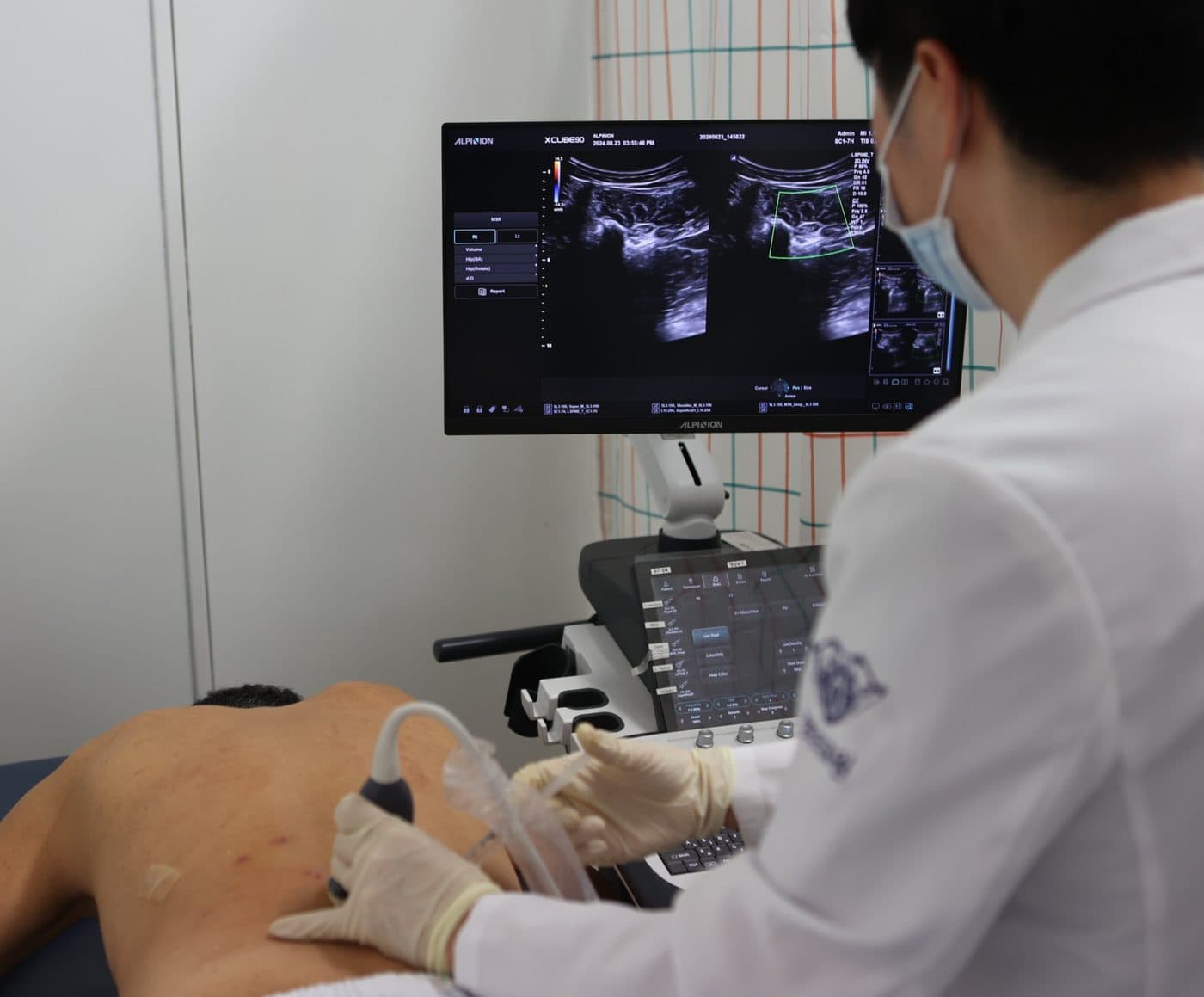
Standardizing ultrasound-guided acupuncture, pharmacopuncture and acupotomy, and verifying their safety and efficacy

1 ongoing grants4 papers

The problem

Acupuncture, pharmacopuncture and acupotomy have relied on surface anatomy and tactile feedback. Visualizing the target with ultrasound can improve precision and safety, but standard protocols and safety and efficacy evidence tailored to Korean medicine procedures are still limited.

Data and methods

  • Region-specific protocols (cervical, lumbar, shoulder, hand) for ultrasound-guided procedures and accumulated clinical cases
  • Case reports and clinical studies collecting safety and outcome data (e.g., ultrasound-guided vagus nerve-targeted pharmacopuncture)
  • A deep-learning system for automatic ultrasound image recognition and procedure assistance in lumbar acupotomy
  • Dissemination through continuing education and congress hands-on sessions

Related grants

  • 2024.08 – 2026.12Deep Learning-based Automatic Ultrasound Image Recognition and Procedure Assistance System for Lumbar AcupotomyKHIDI · Korean Medicine Innovative Technology Development ProgramPrincipal Investigatorin progress

Selected related papers

All papers on this topic (4) →

3D motion analysis

Clinical application of single-camera markerless motion capture and video-based muscle performance assessment

1 ongoing grants1 completed grants3 papers

The problem

Range of motion and posture are basic measures in musculoskeletal care, but goniometry is slow and varies between raters. Quantifying movement with a single camera would allow clinic and research to share the same yardstick.

Data and methods

  • Reliability and validity of single-camera markerless 3D motion analysis (RGB-D sensors) against goniometry in healthy adults and patients
  • Clinical evidence for listing video-based muscle performance assessment as a new health technology
  • Clinical validation within a project developing an image-analysis device for posture, range of motion and spinal alignment in Chuna therapy
  • Systematic review summarizing the performance of existing markerless systems

Related grants

  • 2023.04 – 2027.12Validation Study for Listing Video-based Muscle Performance Assessment as a New Health TechnologyKHIDI · Korean Medicine Digital Convergence Technology Development ProgramSub-project Leaderin progress
  • 2020.04 – 2023.06Development of an Image-analysis Medical Device for Static Posture, Dynamic Range of Motion, and Spinal Alignment in Chuna Manual TherapyKHIDI · Korean Medicine-based Convergence Technology ProgramSub-project LeaderCompleted grants

Selected related papers

All papers on this topic (3) →

Multimodal four-examination AI

Digitizing the four Korean medicine examinations (inspection, listening, inquiry, palpation) into multimodal AI that subtypes pain and predicts prognosis

3 ongoing grants1 completed grants2 papers

The problem

About 85% of chronic low back pain is non-specific, with no cause identified by imaging or biomarkers, and it is a multidimensional condition in which structure, function and emotion intertwine. Treating it under a single label lowers response and promotes chronicity. The goal is to digitize the multidimensional information once handled by the four examinations, identify subtypes, and predict prognosis.

Data and methods

  • Multimodal datasets combining images (posture, facial expression), voice, questionnaires, palpation and biosignals such as pulse waves and heart-rate variability
  • Representation learning (deep autoencoders, clustering) to derive clinical subtypes, with explainable AI to expose the reasoning
  • Chronification and prognosis models using EHR and real-world data
  • Shared data and models with adjacent projects on facial palsy assessment and lumbar ultrasound image recognition

This is an ongoing National Research Foundation project (2026–2031); the subtype and prognosis models are still under development.

Related grants

  • 2026.03 – 2031.02Subtyping Chronic Non-specific Low Back Pain and Developing an Explainable AI Prognostic Model from Multimodal Digital Four-Examination DataNational Research Foundation of Korea (NRF) · Basic Research Program (Ministry of Science and ICT)Principal Investigatorin progress
  • 2025.04 – 2027.12Multimodal AI-based Assessment of Facial Nerve Palsy and Its Application in Korean Medicine PracticeKHIDI · Korean Medicine Innovative Technology Development Program (Translational Research)Co-investigatorin progress
  • 2024.08 – 2026.12Deep Learning-based Automatic Ultrasound Image Recognition and Procedure Assistance System for Lumbar AcupotomyKHIDI · Korean Medicine Innovative Technology Development ProgramPrincipal Investigatorin progress
  • 2023.09 – 2026.02AI-based Korean Medicine Pattern Identification and Chronification Prediction for Nociplastic PainNRF · Basic Science Research Program (First Research Grant)Principal InvestigatorCompleted grants

Selected related papers

All papers on this topic (2) →

Clinical practice guidelines

Korean medicine CPG for herpes zoster and postherpetic neuralgia published (2026); fibromyalgia guideline in development

1 ongoing grants1 completed grants17 papers

The problem

Individual studies do not change practice unless they are organized into a usable form. For chronic intractable pain that medication alone controls poorly, such as postherpetic neuralgia and fibromyalgia, I systematically appraise the evidence for Korean medicine treatment and turn it into recommendations.

Data and methods

  • Systematic reviews and meta-analyses, GRADE evidence and recommendation grading, Evidence to Decision frameworks
  • Surveys of clinical practice, expert consensus (Delphi) and review by related societies
  • Clinical pathways developed alongside the guideline and piloted in practice
  • Large language models as assistants for literature extraction and evidence tables, with human verification

Published: Korean Medicine CPG for Herpes Zoster and Postherpetic Neuralgia (2026)

The guideline presents 32 recommendations, separately for herpes zoster and postherpetic neuralgia, covering acupuncture, electroacupuncture, fire needling, moxibustion, bloodletting cupping and herbal medicine as single or combined Korean medicine treatments and as integrative treatment alongside conventional care. The clinical algorithm includes differential diagnoses and criteria for referral when high-risk complications are suspected. Development followed systematic literature review, a 2024 survey of 1,122 Korean medicine doctors, expert review, GRADE-based grading and review by related societies.

In development: Korean Medicine CPG and Clinical Pathway for Fibromyalgia (2026–2027)

Consolidating the evidence for Korean medicine treatment of fibromyalgia and developing a clinical pathway that includes newer interventions such as ultrasound-guided pharmacopuncture.

Related grants

  • 2026.04 – 2027.12Development of a Korean Medicine Clinical Practice Guideline and Clinical Pathway for FibromyalgiaKorea Health Industry Development Institute (KHIDI) · Korean Medicine Innovative Technology Development ProgramPrincipal Investigatorin progress
  • 2023.07 – 2025.12Development of a Korean Medicine Clinical Practice Guideline and Clinical Pathway for Herpes ZosterKHIDI · Korean Medicine Innovative Technology Development ProgramPrincipal Investigator · guideline published Sep 2026Completed grants

Selected related papers

All papers on this topic (17) →

Grants

Research grants

9 nationally funded grants

Ongoing grants

  1. 2026.04 – 2027.12

    Development of a Korean Medicine Clinical Practice Guideline and Clinical Pathway for Fibromyalgia

    Korea Health Industry Development Institute (KHIDI) · Korean Medicine Innovative Technology Development ProgramPrincipal Investigator

    Clinical practice guidelinesMusculoskeletal pain disorders

  2. 2026.03 – 2031.02

    Subtyping Chronic Non-specific Low Back Pain and Developing an Explainable AI Prognostic Model from Multimodal Digital Four-Examination Data

    National Research Foundation of Korea (NRF) · Basic Research Program (Ministry of Science and ICT)Principal Investigator

    Multimodal four-examination AIMusculoskeletal pain disorders

  3. 2025.04 – 2027.12

    Multimodal AI-based Assessment of Facial Nerve Palsy and Its Application in Korean Medicine Practice

    KHIDI · Korean Medicine Innovative Technology Development Program (Translational Research)Co-investigator

    Multimodal four-examination AI

  4. 2024.08 – 2026.12

    Deep Learning-based Automatic Ultrasound Image Recognition and Procedure Assistance System for Lumbar Acupotomy

    KHIDI · Korean Medicine Innovative Technology Development ProgramPrincipal Investigator

    Ultrasound-guided Korean medicine proceduresMultimodal four-examination AI

  5. 2023.04 – 2027.12

    Validation Study for Listing Video-based Muscle Performance Assessment as a New Health Technology

    KHIDI · Korean Medicine Digital Convergence Technology Development ProgramSub-project Leader

    3D motion analysis

Show 4 completed grants
  1. 2023.09 – 2026.02

    AI-based Korean Medicine Pattern Identification and Chronification Prediction for Nociplastic Pain

    NRF · Basic Science Research Program (First Research Grant)Principal Investigator

    Multimodal four-examination AIMusculoskeletal pain disorders

  2. 2023.07 – 2025.12

    Development of a Korean Medicine Clinical Practice Guideline and Clinical Pathway for Herpes Zoster

    KHIDI · Korean Medicine Innovative Technology Development ProgramPrincipal Investigator · guideline published Sep 2026

    Clinical practice guidelines

  3. 2020.04 – 2023.06

    Development of an Image-analysis Medical Device for Static Posture, Dynamic Range of Motion, and Spinal Alignment in Chuna Manual Therapy

    KHIDI · Korean Medicine-based Convergence Technology ProgramSub-project Leader

    3D motion analysis

  4. 2017.12 – 2020.11

    Multifaceted Evaluation of Integrative Western–Korean Medicine Treatment in Intractable Neuropathic Pain

    KHIDI · Western–Korean Medicine Convergence Technology Development ProgramSub-project Leader

    Musculoskeletal pain disorders

Show 15 grants as co-investigator
  1. 2024.04 – 2025.12

    Steerable Invasive Laser Acupuncture and an XR Platform for Acupuncture Stimulation Delivery in Myofascial Pain Syndrome

    KHIDI · Korean Medicine Digital Convergence Technology Development Program · Co-investigator

  2. 2023.07 – 2023.12

    Korean Medicine and ICT Convergence Acupoint Stimulation Technology for Chronic Pain with Neuropsychiatric Comorbidities

    NRF · Korean Medicine Digital Convergence Technology Development Program · Co-investigator

  3. 2022.01 – 2024.05

    Korean Medicine Research Center for Degenerative Joint Disease

    KHIDI · Korean Medicine Innovative Technology Development Program · Co-investigator

  4. 2021.05 – 2022.12

    Evidence Synthesis on Acupuncture for Reducing Long-term Opioid Use in Non-cancer Pain

    KHIDI · Korean Medicine Innovative Technology Development Program (National Clinical Research) · Co-investigator

  5. 2016.12 – 2017.11

    Integrative Western and Korean Medicine Treatment for Pain Relief and Functional Improvement in Intractable Neuropathic Pain (consortium project)

    KHIDI · Western and Korean Medicine Convergence Technology Development Program · Co-investigator (later sub-project leader)

  6. 2016.08 – 2018.12

    Multicenter RCT and Economic Evaluation of Treatment for Subacute Lumbar Disc Herniation

    KHIDI · Korean Medicine Leading Technology Development Program (CPG Development Project) · Co-investigator

  7. 2016.06 – 2016.12

    Development of a Korean Medicine Clinical Practice Guideline for Chronic Low Back Pain

    KHIDI · Korean Medicine Leading Technology Development Program · Co-investigator

  8. 2016.04 – 2018.12

    Multicenter, Double-blind, Randomized, Placebo-controlled Phase IIb Trial of Hanslim in Obesity

    KHIDI · Korean Medicine Leading Technology Development Program (Herbal Drug Development) · Co-investigator

  9. 2015.06 – 2018.06

    Double-blind, Randomized, Multicenter, Placebo-controlled Phase II Trial of BHH10 in Osteoporosis

    KHIDI · Korean Medicine Leading Technology Development Program (Herbal Drug Development) · Co-investigator

  10. 2014.06 – 2015.06

    Efficacy and Mechanism Study for an Anti-obesity Herbal Drug Based on Lipid Metabolism

    KHIDI · Korean Medicine Leading Technology Development Program (Herbal Drug Development) · Co-investigator

  11. 2009.05 – 2011.04

    Development of a Combined TCD and EEG Brain Imaging Device for Acupuncture and Its Interpretation Database

    KHIDI · Korean Medicine Leading Technology Development Program · Co-investigator

  12. 2009.03 – 2009.11

    Survey of Clinical Trial Outcome Measures for Herbal Drugs in Chronic Pain Disorders

    National Institute of Food and Drug Safety Evaluation · Herbal Medicine Safety Research · Co-investigator

  13. 2008.12 – 2010.06

    Development of a Korean Medicine Low Back Pain Scale and a Randomized Double-blind Trial Comparing Ojeok-san Extraction Methods

    KHIDI · Korean Medicine Treatment Technology Development Program · Co-investigator

  14. 2008.06 – 2011.06

    Development of Acupuncture Clinical Practice Guidelines for Musculoskeletal Disorders

    KHIDI · Korean Medicine Leading Technology Development Program · Co-investigator

  15. 2008.05 – 2010.03

    Development of HT008, a Natural Product-derived Functional Food for Joint Function in Older Adults

    KHIDI · Health Technology R&D Program · Co-investigator

Interested in collaborating on this topic?